How to Get to Jökulsárlón from Reykjavík
How to get to Jökulsárlón from Reykjavík comes down to one road: the lagoon is 380 km east on Route 1, which is about five hours of driving without stopping, and Skaftafell is 330 km and roughly four. Almost nobody manages it without stopping. There is no scheduled service that puts you at a glacier base camp for a morning departure, so the realistic options are a rental car, a paid transfer, or a multi-day tour that sleeps you in the southeast. This page covers all three, where to break the drive, and why the answer changes completely between July and January.
Quick answer
Drive Route 1 east: 330 km to Skaftafell in about four hours, 380 km to Jökulsárlón in about five. There is no bus that reaches either glacier meeting point in time for a tour, so a rental car or an organised transfer is the practical choice. In winter, five hours of driving against four to eight hours of daylight is why most people sleep in the southeast rather than day-trip.
Key takeaways
- Reykjavík to Jökulsárlón: 380 km, about 5 hours non-stop, all on paved Route 1
- Reykjavík to Skaftafell: 330 km, about 4 hours, and the base camp for half the tours here
- No scheduled public transport reaches either meeting point for a morning departure
- Winter driving means checking road.is the night before and again at breakfast
- The realistic day-trip window is May to August, when daylight runs 16 to 21 hours
- Between November and March, book a bed in Höfn or Kirkjubæjarklaustur instead
The Three Ways to Get There
Nothing else works, and the differences are mostly about what happens to your day rather than what happens to your wallet.
| Option | What it costs | Time on the road | Best for |
|---|---|---|---|
| Rental car, sleeping in the southeast | From about $45 a day in winter plus fuel | 5 hours out, 5 back, split across days | Anyone doing more than one thing on this coast |
| Rental car, day trip from Reykjavík | Same car, one very long day | 10 hours of driving in a single day | Summer only, and only if you enjoy driving |
| Organised day tour from Reykjavík | Considerably more than the cave itself | 10 to 12 hours, mostly seated | Non-drivers, and winter visitors without a car |
| Multi-day tour with accommodation | The most expensive per day | Spread over two or three days | Anyone nervous about winter driving conditions |
The pattern worth noticing: the cave ticket is the same $161 whichever of these you choose. What you are buying with the more expensive options is transport and someone else's judgement about the roads. Meeting points and departure times for every tour sit with Vatnajökull ice cave tours and meeting points.
The Drive, Stop by Stop
One road, east, the whole way. These are the stops most people actually make, with the distance from Reykjavík.
Driving It Yourself
Distances and drive times from Reykjavík
All on Route 1, all paved, and all measured from the centre of Reykjavík. Winter times run longer.
| Destination | Distance | Drive time | Why you stop |
|---|---|---|---|
| Seljalandsfoss | 120 km | 1 h 40 | The waterfall you can walk behind |
| Skógafoss | 150 km | 2 h | Fuel, food, second waterfall |
| Vík | 180 km | 2 h 20 | Last town of size for 90 minutes; black beach |
| Kirkjubæjarklaustur | 270 km | 3 h 20 | Fuel, food and beds, 70 km short of Skaftafell |
| Skaftafell | 330 km | 4 h | Base camp for the Falljökull cave and hike tours |
| Fjallsárlón | 370 km | 4 h 45 | Quieter lagoon, glacier front close to the viewpoint |
| Jökulsárlón | 380 km | 5 h | Meeting point for the Breiðamerkurjökull cave tours |
| Höfn | 460 km | 6 h | Largest town on this coast, 80 km past the lagoon |
The road is easier than people expect
Route 1 to Jökulsárlón is paved the whole way, mostly single carriageway, with a 90 km/h limit outside built-up areas and 80 on some stretches. No F-road, no gravel, no river crossing. A two-wheel-drive car does it fine in summer, and does it fine in winter when the road is open.
What makes it a long drive is not difficulty but distance and the stops. Seljalandsfoss, Skógafoss, the black beach at Vík and the canyon at Fjaðrárgljúfur all sit within a few minutes of the road, and five hours of driving becomes eight hours of day very easily.
Budget a full day each way if you want to see anything, or drive it straight and see it on the way back.
Winter is a different question
Between November and March the road closes for wind and snow with little warning, sometimes for a few hours and sometimes for a day. Check road.is the night before and again at breakfast, and treat a closure as final rather than as advice.
The second constraint is light. In December you have around four hours of it, so a 380 km drive means arriving and leaving in the dark, on a road with no lighting and frequent single-lane bridges.
Winter tyres are legally required from 1 November to 14 April and every rental will have them. What rentals will not cover is damage from driving in a closed-road warning, which is the one insurance exclusion worth reading.
Fuel and the new road tax
Petrol runs around 222 ISK a litre as of July 2026, roughly $1.77, down from about 300 ISK the year before after a fuel tax cut. Since 1 January 2026 Iceland has charged road use per kilometre instead, and that applies to rental cars, so ask how your company bills it.
Stations are frequent enough to Vík and thin after it. Fill up in Vík or Kirkjubæjarklaustur rather than assuming there is something between them and the lagoon.
Without a Car
This is where honesty matters more than optimism. There is no scheduled bus that will get you from Reykjavík to a glacier base camp in time for a morning cave departure and back again, and no rail of any kind in Iceland.
What exists instead: organised day tours from Reykjavík that fold the drive, the cave and usually the lagoon into ten to twelve hours, and multi-day tours that sleep you on the coast. Both cost considerably more than the $161 cave ticket, because you are buying the ten hours of driving as well.
If you are staying in the southeast already, a few operators run transfers from local accommodation to the meeting points. Ask when you book rather than assuming, since these are not published everywhere.
Jökulsárlón or Fjallsárlón?
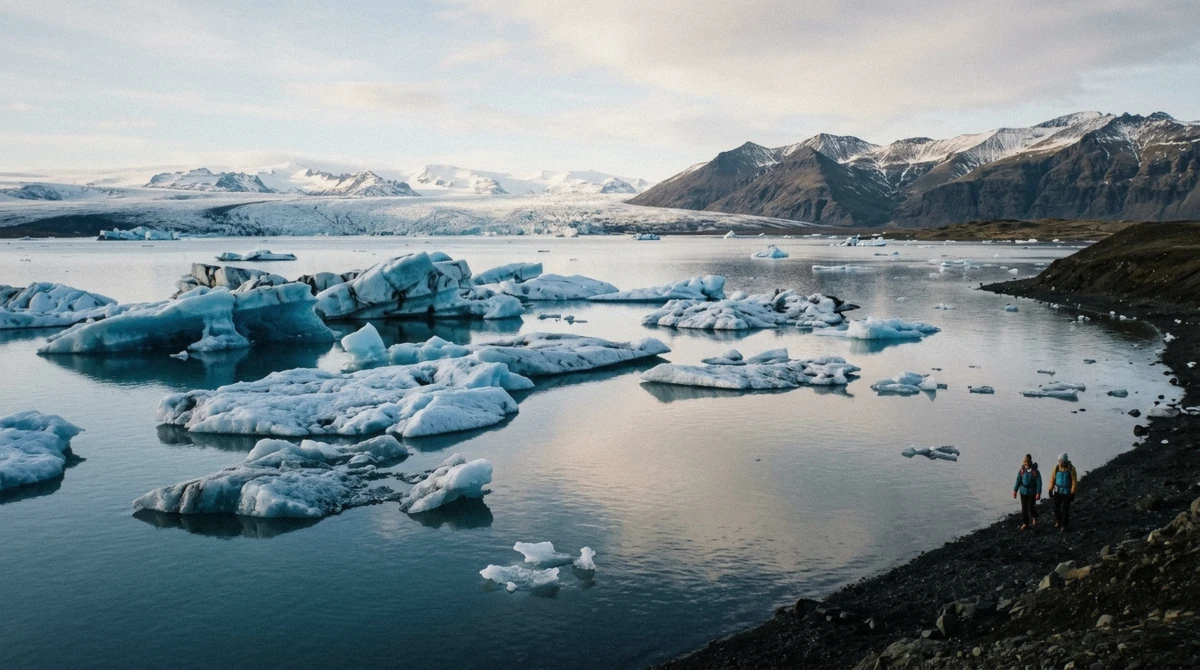
This comes up constantly, and the honest answer is that they are different rather than ranked. Fjallsárlón sits 10 km west of Jökulsárlón on the same road.
Jökulsárlón is bigger, deeper at 248 metres, and the one with the icebergs drifting toward the sea and washing up on Diamond Beach across the bridge. It is also where the cave tours meet, and where the car park fills between eleven and three.
Fjallsárlón is smaller and much quieter, and its advantage is proximity: the glacier front sits close to the viewpoint, so you see the ice wall properly rather than as a white line across the water.
If you have one stop, make it Jökulsárlón, because Diamond Beach comes with it. If you have two, do Fjallsárlón first while it is quiet.
How Long to Spend
For the lagoon itself, an hour is enough to walk the shore and cross to Diamond Beach, and two is comfortable. Add a cave tour and you are committing two and a half to four hours on top, at a fixed departure time you cannot move.
The sequence that works: sleep nearby, take the first cave departure, spend the afternoon at the lagoon and the beach when the light is low and the coaches have gone, then drive on. The sequence that does not: drive from Reykjavík, arrive at one, rush a tour at two, and drive back in the dark.
If you are choosing where to sleep, where to stay near the ice caves covers the two towns and the roadside clusters between them. If you are still weighing whether to add a tour at all, are the ice caves worth it and what the whole trip costs price both sides of that decision.
Questions About the Journey
How far is Jökulsárlón from Reykjavík?
About 380 km by road, all of it on Route 1, which takes roughly five hours of driving without stops. Skaftafell, where half the tours on this glacier meet, is 330 km and about four hours. In practice most people take considerably longer, because Seljalandsfoss, Skógafoss and Vík all sit a few minutes off the road on the way.
Is there a bus from Reykjavík to Jökulsárlón?
Not one that works for a tour. There is no scheduled service that puts you at the Jökulsárlón car park or a Skaftafell base camp in time for a morning departure and gets you back the same day, and Iceland has no passenger rail at all. Without a car, the realistic options are an organised day tour from Reykjavík or a multi-day tour that includes accommodation on the coast.
Can you visit the ice caves as a day trip from Reykjavík?
Physically yes, sensibly only in summer, and the caves are shut in summer. A winter day trip means ten hours of driving in four to eight hours of daylight, on a road that closes for weather, to reach a tour that can itself be cancelled. Organised day tours do exactly this and manage it, but sleeping in the southeast is a much better trip.
Do you need a 4x4 to drive to Jökulsárlón?
No. Route 1 is paved the whole way from Reykjavík, and a two-wheel-drive car handles it in summer and in winter whenever the road is open. Winter tyres are required by law from 1 November to 14 April and every rental has them. The 4x4 you see in the photographs belongs to the tour operator, for the glacier track beyond the car park.
Where should you stop between Reykjavík and the glacier lagoon?
Seljalandsfoss at about 120 km, Skógafoss at 150, Vík at 180 for fuel and food, and Kirkjubæjarklaustur at 270 for the last real services before Skaftafell. Petrol stations thin out considerably after Vík, so fill up there or at Kirkjubæjarklaustur rather than assuming something sits between them and the lagoon.
How long does the drive take in winter?
Allow six hours rather than five, and be ready for it to be impossible. Wind and snow close Route 1 with little warning between November and March, and the four to eight hours of daylight in that window means much of the drive happens in the dark. Check road.is the night before and again in the morning, and treat a closure as final.