Can You Visit an Ice Cave in Iceland Without a Tour?
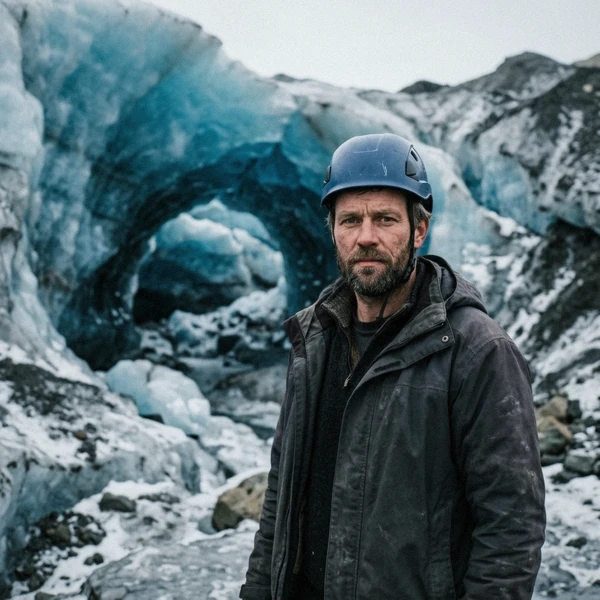
You cannot visit an ice cave without a tour in Iceland. Entering one on Vatnajökull without a certified glacier guide is not permitted, and it is the one thing on this coast I would call genuinely dangerous rather than merely inadvisable. What you can do alone is a great deal more than most people realise: five places within an hour of each other put you next to the ice, the icebergs and a glacier front for the price of parking. This page draws the line in the exact place it actually sits, and prices both sides of it as of July 2026.
Quick answer
You cannot enter an ice cave in Iceland without a guide: Vatnajökull National Park requires certified guiding for cave access, and the caves are assessed daily by the operators before anyone goes in. You can reach five viewpoints, lagoons and glacier fronts on your own for 1,040 ISK a day in parking, about $8.30. The guide requirement starts the moment you leave marked ground and step onto glacier ice.
Key takeaways
- Verdict: no cave without a guide, but everything up to the ice is open to you
- DIY cost for a full day on this coast: 1,040 ISK parking at each of two sites, with 50 per cent off the second if paid the same day
- What a tour genuinely adds: the cave itself, crampons and a route across crevassed ice that has been checked that morning
- The safety line: marked trails and shorelines are yours, glacier ice is not, and there is no grey area in between
- Best free spot: the marked trail to the Skaftafellsjökull glacier front, around 3.7 km there and back on flat ground
- Cheapest guided option if you change your mind: a three-hour glacier hike from $97
The Short Answer
Ice caves on Vatnajökull are accessible only with a certified glacier guide. This is not an operator preference dressed up as a rule: the caves sit inside Vatnajökull National Park, the park sets the terms of access, and since November 2024 every company running cave tours has had to appoint a lead guide who takes part in a daily assessment of each cave and the ice hanging above it.
The practical enforcement is simpler than the regulation. Cave entrances are not marked, they move every season, and most of them sit at the end of glacier tracks that ordinary rental cars are neither built nor insured to cross. Nobody stops you at a barrier because there is no barrier. There is just a glacier that changes weekly and a set of crevasses under thin snow.
What is genuinely open to you is the rest of it: two glacier lagoons, a black beach full of icebergs, a marked trail that ends at a glacier front, and a waterfall walk. All of it for parking money. The guided departures, if you want the comparison, are on the guided Vatnajökull cave options.
On Your Own or With a Guide, Side by Side
Both columns below are real. The DIY one is not a consolation prize, and the tour one is not a rip-off; they buy different things.
| On your own | With a tour | |
|---|---|---|
| Cost per person | 1,040 ISK parking per site, about $8.30, plus fuel | $97 for a glacier hike, $161 to $170.51 for a cave |
| What you can reach | Lagoon shores, Diamond Beach, Fjallsárlón, marked trails, the front of Skaftafellsjökull | Onto the ice itself, and inside a cave from November to March |
| Gear | Your own boots and layers; nothing technical needed on marked ground | Helmet, crampons, headlamp, plus harness and ice axe on hikes |
| Safety and backup | You, a mobile signal that comes and goes, and no one expecting you back | A guide who assessed the route that morning and turns the group around when it changes |
| Time and flexibility | Entirely yours, stop and go as you like, no booking | Two and a half to four and a half hours at a fixed departure time |
| Best for | Anyone with a rental car, a spare day and no interest in walking on ice | Anyone who came for the blue ice itself |
Five Places You Can Reach Alone
All five sit on or just off Route 1 between Skaftafell and the glacier lagoon, a 60 km stretch you could drive in under an hour without stopping. Nobody manages that.
How Far You Can Get on Your Own
Jökulsárlón glacier lagoon
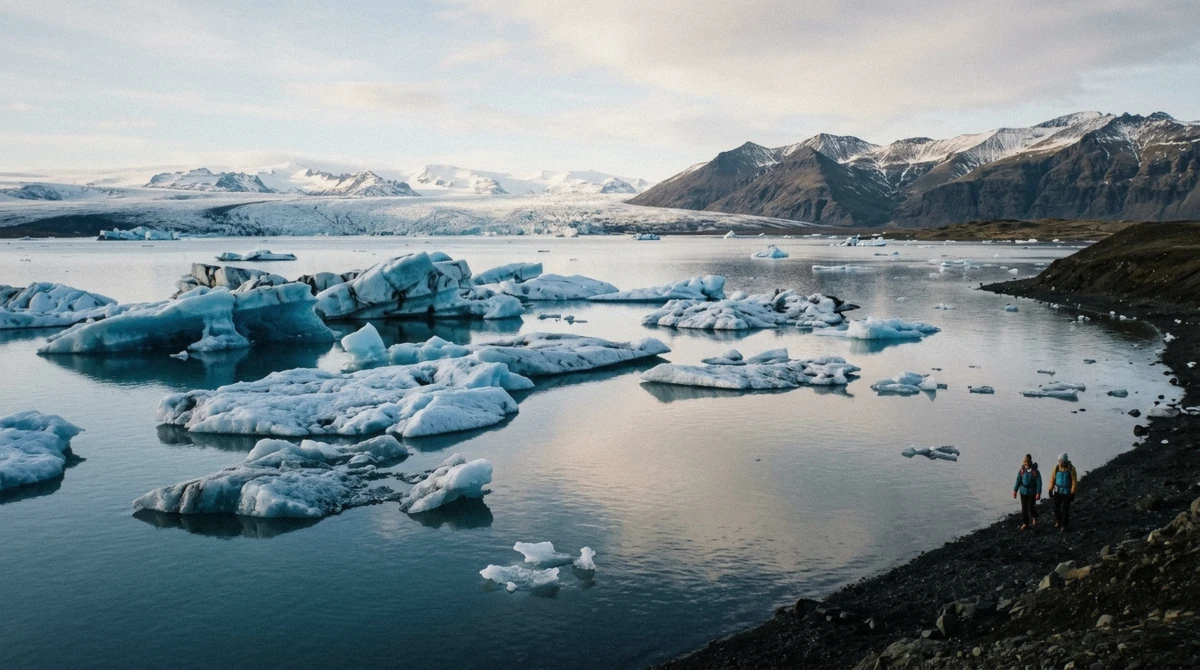
The lagoon appeared as Breiðamerkurjökull retreated through the last century, and it now reaches 248 metres deep, making it the deepest lake in Iceland. Icebergs break off the glacier at the far end and drift toward the sea.
Parking is 1,040 ISK for the calendar day, about $8.30 at 125 krónur to the dollar in July 2026, and you can come and go until midnight on one payment. If the main lot is full, or you would rather not pay, there is a free alternative area roughly 2.3 km further from the glacier.
Come early or late. Between eleven and three in summer the car park is at capacity.
Diamond Beach
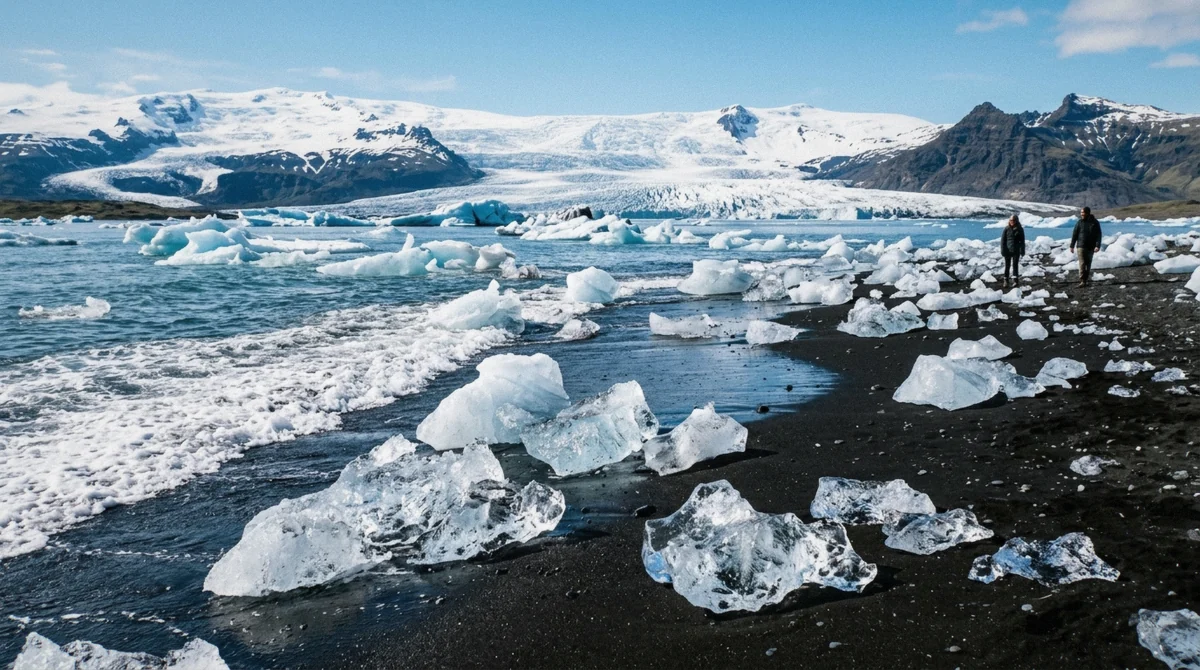
Two minutes south across the bridge, where the icebergs that make it out of the lagoon get pushed back onto black volcanic sand by the surf. The contrast is the reason it is photographed more than the lagoon itself.
The ice here changes every tide, so a beach thick with car-sized blocks one morning can be nearly bare the next. Nobody can tell you in advance which you will get.
Stay well back from the water. The waves on this stretch are stronger than they look and the sand shelves steeply.
Fjallsárlón
Ten kilometres west of Jökulsárlón and a fraction as busy. The lagoon is smaller, which works in its favour: the glacier front sits much closer to the viewpoint, so you see the ice wall properly rather than as a white line on the horizon.
If you have time for only one lagoon and want the glacier rather than the icebergs, come here instead. There is a café and no parking charge at the time of writing.
The Skaftafellsjökull trail
This is the best free thing on the whole coast, and the one visitors miss. A marked, flat trail runs from the Skaftafell visitor centre to the front of Skaftafellsjökull, roughly 3.7 km there and back, ending at a small lagoon with the glacier tongue rising directly in front of you.
No gear, no guide, no fitness requirement beyond an hour of easy walking. It is the closest you get to glacier ice without stepping on it, and it is where I would send anyone who has decided against a tour.
The trail ends at the water. Do not walk out onto the ice or the icebergs, however solid they look.
Svartifoss
From the same visitor centre, a 1.5-hour return walk up to a waterfall framed by hexagonal basalt columns. It climbs steadily rather than steeply, and the columns above the fall are the reason the walk exists.
Parking at Skaftafell is 1,040 ISK a day, and if you already paid at Jökulsárlón that calendar day you get 50 per cent off here. Keep the receipt.
Where the Guide Requirement Starts
The line is the edge of the ice
Marked trails, shorelines and viewpoints are yours. The moment you step onto glacier ice, you are in guided territory, and that includes the apparently flat, apparently solid tongue at the end of the Skaftafellsjökull trail.
There is no checkpoint and no ranger stationed to stop you. The enforcement is physical rather than administrative: crevasses open under snow bridges that hold a footprint and not a person, the surface changes week to week, and the front of a glacier calves without warning.
Cave entrances add a second layer, because they are unmarked, they move every season, and the roof is a structure someone qualified needs to read that morning.
Why the caves specifically are guided-only
Every cave used by tours here is assessed daily by an experienced lead guide, along with the overhanging ice around it, and dropped for the day if it fails. That requirement came in after a fatal collapse on Breiðamerkurjökull in August 2024, covered in full in our guide to ice cave safety.
An independent visitor has none of that. You would be entering an unmarked feature, with no assessment, no helmet, and nobody who knows where you are.
What a tour actually buys
Three things, in order of value. The daily reading of the ice, which is the part you cannot replicate. The route across crevassed ground to reach the cave at all. And the crampons, helmet and headlamp that make walking on it routine rather than an adventure.
The cheapest way over that line is a three-hour glacier hike from $97, which puts you on the ice with all of the above and none of the cave. The three Skaftafell hikes compared covers those.
What a DIY Day Actually Costs
For two people driving the Ring Road, a full day covering everything on the map above breaks down like this. It is genuinely cheap by Icelandic standards.
| Item | Cost | Note |
|---|---|---|
| Jökulsárlón parking | 1,040 ISK (about $8.30) | Valid until midnight, in and out as often as you like |
| Skaftafell parking | 520 ISK (about $4.15) | Half price on the same calendar day if you paid at Jökulsárlón |
| Diamond Beach | Included | Same payment as the lagoon, across the bridge |
| Fjallsárlón | No charge | Café on site if you want one |
| Fuel, Skaftafell to the lagoon and back | Around $14 | About 130 km of driving at roughly 222 ISK a litre |
| Day total for two people | Around $25 | Against $322 for two on the cheapest cave tour |
Roughly twenty-five dollars against three hundred and twenty. That gap is the honest reason this page exists: if the cave itself is not the thing you came for, this coast rewards you for nothing more than parking and a pair of walking shoes.
Safety Rules, Either Way
These apply whether you booked anything or not, and they are the ones local rescue teams repeat every winter.
- Never walk onto glacier ice, a glacier tongue, or an iceberg, however solid it looks from the shore
- Never enter an ice cave or a crevasse without a certified guide, in any season
- Stay back from the surf at Diamond Beach, where the shelving sand and cold water are a genuine hazard
- Check road.is before driving in winter, and again at breakfast, because closures here happen fast
- Do not park on the verge of Route 1 for a photograph; use the lots, which is what the fee funds
- Tell someone your plan if you are walking a trail alone out of season
Questions About Going It Alone
Can you see ice caves in Iceland without a tour?
You can see glacier ice, glacier fronts and icebergs without a tour, but you cannot enter an ice cave. Cave access on Vatnajökull requires a certified glacier guide, the entrances are unmarked and move every season, and each one is assessed daily before groups go in. The nearest you get independently is the marked trail to the front of Skaftafellsjökull, about 3.7 km there and back.
Which ice caves in Iceland are easiest to access?
Easiest by tour, not on your own. The super jeep tours from Jökulsárlón involve the least walking, because the vehicle covers the ground and they take children from age 6; both super jeep tours are compared here. There is no cave anywhere in Iceland that you can walk into unguided, including the man-made ice tunnel on Langjökull, which is also a ticketed and guided visit.
Is it free to visit Jökulsárlón glacier lagoon?
The lagoon itself is free to walk around; parking costs 1,040 ISK for the calendar day, roughly $8.30. One payment covers you until midnight and lets you come and go. A free alternative parking area sits about 2.3 km further from the glacier if the main lot is full or you would rather not pay. Diamond Beach is covered by the same payment.
Can you walk on a glacier in Iceland without a guide?
No, and it is the mistake that keeps rescue teams busy. Glacier surfaces hide crevasses under snow bridges that will hold a footprint but not a person, and the front of a glacier calves without warning. Marked trails to a glacier front, like the Skaftafellsjökull path, are safe and open to anyone. The ice itself starts where the trail ends.
What can you do at Jökulsárlón without booking anything?
Walk both shores of the lagoon, watch icebergs drift toward the outlet, cross the bridge to Diamond Beach for the ice on black sand, and drive ten kilometres west to Fjallsárlón for a closer view of a glacier front. Seals are often visible in the lagoon. All of it costs one parking payment and as much of the day as you want to give it.
Is a glacier hike worth it if I have already seen the lagoon?
Yes, and it is the cheapest way over the line. From $97 you get crampons, a helmet, a certified guide and three hours on ice you cannot otherwise set foot on, with crevasses and meltwater channels that are invisible from the shore. It runs every month of the year, unlike the caves.