Are Iceland's Ice Caves Safe?
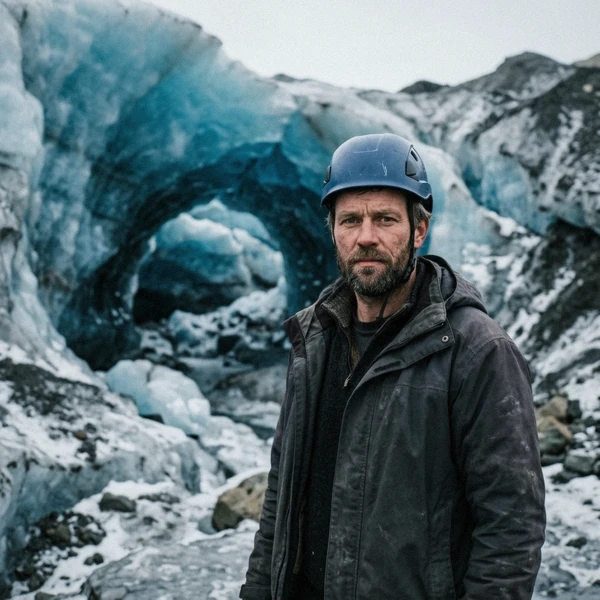
Are Iceland ice caves safe? Guided visits on Vatnajökull are, for the overwhelming majority of people who do them, and the rules got materially stricter after one fatal accident on this glacier in August 2024. What changed is not marketing language: operators now appoint a lead guide who takes part in a daily assessment of every cave and the ice hanging above it, and the site is dropped for the day if it fails. What has not changed is the underlying fact that a glacier is an active structure. I have scouted these features since 2014, and this page covers what actually goes wrong, what stops it, and who the operators will not take.
Quick answer
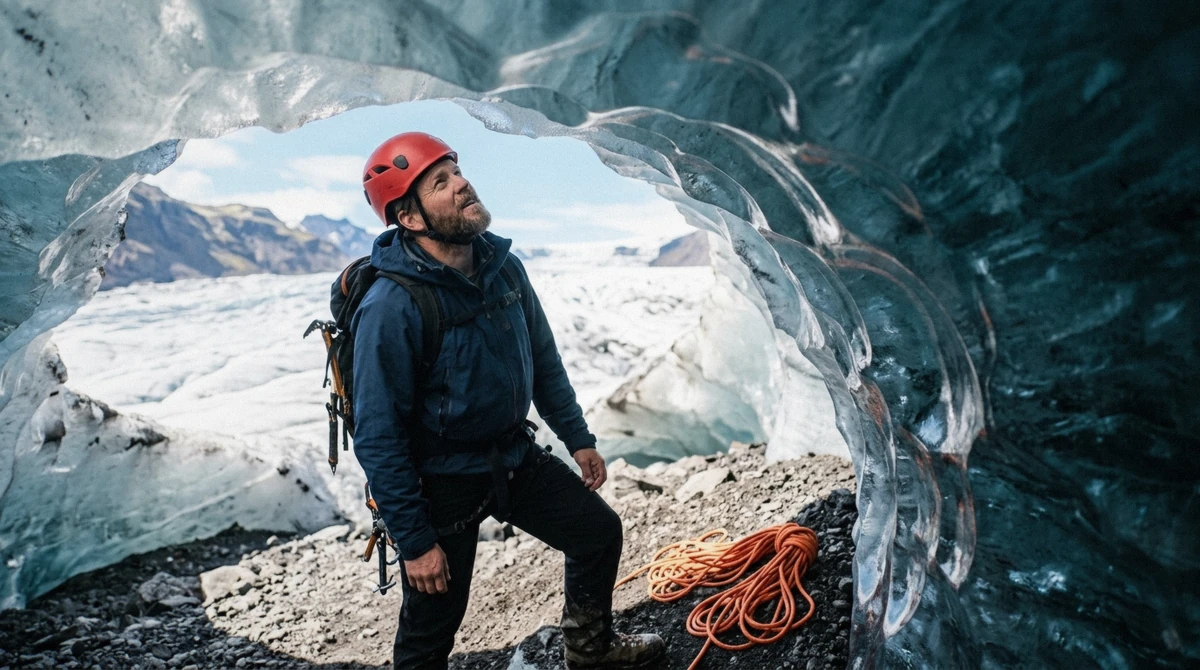
Yes, with a certified guide and inside the November to March season. Hundreds of thousands of people have visited these caves without incident, and one fatal accident in August 2024 led Vatnajökull National Park to require daily safety assessments of each cave before any group enters. The real risks are falling ice at the entrance, crevasses on the approach and the weather on the drive, and every one of them is managed by the guide rather than by you.
Key takeaways
- One fatality on this glacier in recent years, on 25 August 2024, outside the normal winter cave season
- Since November 2024 operators must appoint an experienced lead guide who takes part in a daily assessment of each cave and its overhanging ice
- Entering a cave without a certified guide is not permitted and is the single most dangerous thing a visitor can do here
- Minimum ages run from 6 to 10 depending on the tour; pregnancy, heart conditions and recent surgery exclude you from some of them
- Wind, not the cave, is what cancels most departures, and the go or no-go call belongs to the guide
- If you are excluded on medical grounds, the lagoon, Diamond Beach and a short glacier walk are still open to you
Who Should Think Twice
If you are pregnant
several operators exclude you outright, so check the specific tour before paying, and read the restriction table below
If you have a heart condition or have had recent surgery
the longer hikes rule you out; a short super jeep cave tour may still work, but tell the operator in advance
If you are strongly claustrophobic
take a super jeep cave tour with a wide entrance rather than a walking tour, or take a crevasse walk with open sky above instead
If you use a wheelchair or have a mobility impairment
no cave tour on this glacier is open to you, and the honest alternatives are further down this page
If you are travelling between April and October
there is no natural cave to enter, and that closure is a safety decision as much as a seasonal one
The Safety Record: What Actually Happened
The 2024 accident, plainly
On 25 August 2024 an ice cave on Breiðamerkurjökull collapsed while a guided group of around 23 people was there. One visitor, an American, was killed by falling ice, and his wife was seriously injured and flown to Reykjavík. A search involving roughly 200 people and two helicopters followed, before police confirmed that nobody else was missing.
That is the only fatal ice cave accident on this glacier in the modern era of these tours, against a visitor volume that runs to hundreds of thousands over the same period. Stating it that way is not a defence of the risk. It is the context that makes the response afterwards meaningful.
The date matters as much as the event. Late August is outside the natural cave season entirely: the meltwater that carves these features was still running, and the ice was in its least stable condition of the year. A 2017 risk assessment had already warned against summer cave visits.
Every current departure and its restrictions are listed with the Vatnajökull cave tours on offer.
What changed after it
Vatnajökull National Park suspended ice cave tours on Breiðamerkurjökull immediately, then worked through the autumn on a stricter framework that was finalised in November 2024.
Under it, every company running cave tours must appoint an experienced lead guide who takes part in a group carrying out daily safety assessments of each cave and of the overhanging ice formations around it, including ice walls and moulins. If the assessment says the site is unsafe, operators avoid that location for the day.
A professional council oversees the system, with representatives from the operators, the national park, the Icelandic Travel Industry Association, the East-Skaftafell Tourism Association and the Icelandic Association of Mountain Guides. Operators fund it in proportion to their client numbers. That is a genuine structural change, not a press release.
What Makes It Safer Here
Who is actually in charge
Vatnajökull National Park is the authority. It controls access to the ground the caves sit on, it sets the terms operators work under, and it can and did shut the whole activity down within hours of an accident.
Guiding qualifications come from the Icelandic Association of Mountain Guides, whose members sit on the oversight council. Ask any guide on this glacier what their certification is and you will get a straight answer, because it is the thing they are proudest of.
The honest limitation is that the daily assessment is a judgement made by people, on ice that changes weekly. It is a good system run by experienced practitioners, and it is not a guarantee. Anyone telling you a glacier is risk-free is selling something.
The go or no-go call
Three separate things get assessed before a group moves: the cave and the ice above its entrance, the glacier track the vehicles cross, and the weather. Any of them can stop a departure on its own.
Wind is the most common cause. Above roughly 20 metres per second the exposed outwash plain becomes the problem rather than the cave. Rain during a mid-winter thaw is the second, because water moving back through the channels undermines a roof in hours.
The decision sits with the guide on the morning, not with an office, and not with you. Guides here cancel readily, which is the behaviour you want.
The Real Risks, and What Manages Them
Four mechanisms account for essentially everything that goes wrong on this glacier. None of them is exotic, and each has a specific control attached.
| Risk | What a good operator does | Warning sign |
|---|---|---|
| Ice falling from the entrance or roof | Daily assessment of the cave and every overhanging formation above it; the site is dropped for the day if it fails | A guide who has not been to the cave that morning, or who cannot say when it was last checked |
| Crevasses on the approach | A route scouted that day, the group walking in single file, harnesses near open edges | Groups spreading out to take photographs with nobody calling them back |
| Slips on ice and rubble | Crampons fitted individually and a technique briefing on flat ice before anyone moves | Crampons handed out at the base camp for you to fit yourself |
| Weather closing the track | Departure cancelled outright rather than shortened, with a full refund | Any suggestion of squeezing the trip in before the wind arrives |
The pattern in that table is worth naming: the thing that keeps you safe is a person making an unpopular call, not equipment. Helmets and crampons are necessary and they are not the control that matters most.
How to Choose an Operator
What to ask, and what to watch
Every operator whose tours we track works under the national park framework, so the questions below are less about weeding out cowboys than about knowing what a good morning looks like.
- Ask when the cave was last assessed. The answer should be today, and it should come without hesitation
- Ask what the group size per guide is. Twelve to fourteen is normal here; more than that in a narrow chamber is not
- Green flag: an unhurried gear fitting where the guide checks your boots before your ticket
- Green flag: a guide who talks about what would make them turn the group around
- Red flag: crampons issued without anyone watching you walk in them
- Red flag: any pressure to go ahead on a marginal morning
Three that publish the detail
The four-hour Skaftafell blue ice cave and glacier hike caps groups at twelve per guide and issues a harness and ice axe alongside the helmet and crampons. The Blue Ice Maze crevasse walk does the same and has no roof over it at all, which some nervous visitors prefer. Both cave tours from the Jökulsárlón car park split into parties of around ten on the ice.
All three run under the same assessment regime, and all three refund in full when they call a morning off.
Who Cannot Do It
Restrictions differ by operator, and every one below comes from the tours' own listings rather than from general advice. Check the specific departure before paying, because the tour that suits your group may not be the cheapest one.
| Restriction | Typical rule on these tours | Why it exists | Ask before booking if… |
|---|---|---|---|
| Minimum age | 6 on the super jeep cave tours, 8 on most Skaftafell tours, 10 on the walking cave tours and the long lagoon hike | Distance on uneven ice, not the cave itself | Your child is between 6 and 10 and you want the cave rather than a hike |
| Maximum age | None on any tour here | Fitness matters, birth year does not | You are unsure about the walking distance rather than your age |
| Pregnancy | Excluded on the small-group Skaftafell hike, the long lagoon hike and the short Skaftafell hike | Fall risk on ice and remoteness from medical help | You are pregnant and any tour you are considering does not state a rule |
| Heart conditions and blood pressure | Excluded on the 4.5-hour lagoon hike | Sustained exertion far from a road | You have a cardiac condition, on any tour longer than three hours |
| Recent surgery | Excluded on the 4.5-hour lagoon hike | Uneven ground and a long walk out if something goes wrong | You have had any surgery in the last few months |
| Low general fitness | Stated outright as an exclusion on the 4.5-hour lagoon hike | Four and a half hours on ice is genuinely tiring | You would struggle with a two-hour country walk |
| Mobility impairments | Excluded on most cave tours and both crevasse walks | Rubble, old snow and cave entrances that require stooping | You use any walking aid |
| Wheelchair users | Excluded on all tours here | There is no wheeled access to any point on the glacier | You are looking for an accessible glacier experience |
| Intoxication | Refused at the meeting point, on every tour | Crampon technique and judgement on ice | Never a question worth asking |
Two of these catch people out repeatedly. The 4.5-hour hike from the lagoon carries by far the longest exclusion list of any tour on this glacier, and pregnancy is not mentioned on some listings at all, which means asking rather than assuming.
What Happens If Something Goes Wrong
The weather turns while you are on the ice
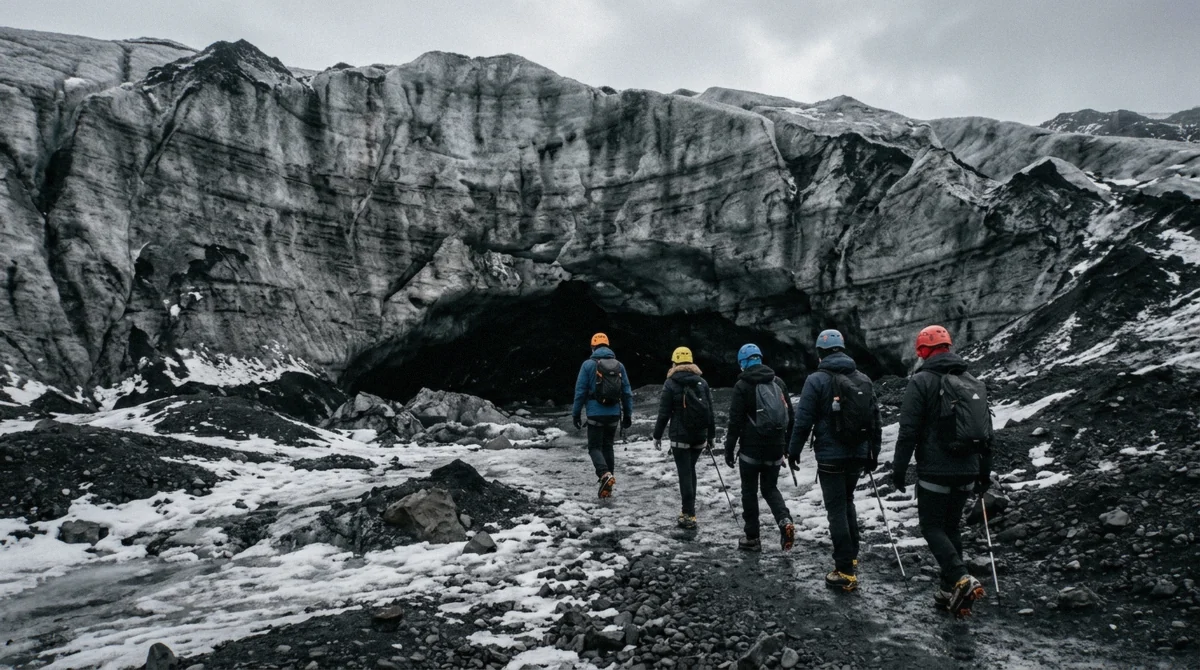
It happens regularly. What follows is a shortened route rather than a dramatic evacuation: the guide turns the group back from the upper glacier, you see less than you hoped, and you walk out the way you came.
Your job here is to move when asked without negotiating for five more minutes of photographs. Groups that argue are the reason a turn-around takes twice as long as it should.
Somebody in the group struggles
On a small-group tour the guide has the ratio to deal with it, which is most of what group caps are for. Usually it means a slower pace or a shorter route for everyone.
If you know you are the likely candidate, say so at the meeting point rather than at the halfway mark. Guides plan around a declared limitation easily and around a hidden one badly.
You panic inside the cave
The chambers are wider than most people expect and the entrance is always in sight in the ones the operators use, but claustrophobia does not negotiate with facts. Tell the guide before you go in, stay near the mouth, and step out whenever you want.
Nobody will make an issue of it. On a busy morning at least one person in three groups does exactly this.
The one lever you control
Everything above is handled by someone else. The single safety decision that belongs to you is honesty at the booking stage and at the meeting point: your medical conditions, your fitness, and what you are actually able to do.
Every serious problem I have seen on this glacier started with somebody deciding a restriction did not really apply to them.
If You Are Excluded, What Is Left
Being ruled out of a cave does not rule out this coast. Two of the three best things here cost nothing beyond parking, and one paid alternative asks far less of you than a cave does.
- Jökulsárlón lagoon and Diamond Beach: icebergs from the shore, flat ground, 1,040 ISK a day to park, and no exclusions of any kind
- Fjallsárlón, a quieter lagoon 10 km west of Jökulsárlón with the glacier front much closer to the viewpoint
- The short Skaftafell glacier hike at $97 for three hours, the least demanding way onto the ice, though pregnancy and heart conditions still exclude you
- The Blue Ice Maze crevasse walk at $125.50, which has blue ice walls but no roof, for anyone whose concern is enclosure rather than exertion
One more honest option: read what you can see without any tour at all. A large part of what people come to this coast for is visible from a car park, and none of it carries a medical restriction.
The short version is that this is a well-run activity on terrain that will never be entirely tame, and the people managing it treat both halves of that sentence seriously. Book inside the season, book a guide, tell them the truth about yourself, and accept a cancellation without arguing. Do that and you are as safe here as on any mountain activity in Europe.
All the current departures and their restrictions sit with guided ice cave tours on Breiðamerkurjökull.
Safety Questions People Ask
Has anyone died in an Icelandic ice cave?
Yes. On 25 August 2024 a cave on Breiðamerkurjökull collapsed during a guided visit, killing one American visitor and seriously injuring his wife. It is the only fatal ice cave accident on this glacier in the modern history of these tours. It happened in late August, outside the November to March season, when meltwater was still running and the ice was at its least stable. Vatnajökull National Park suspended tours and then imposed the daily-assessment rules that operators work under now.
Can ice caves collapse while you are inside?
It is physically possible, which is why the whole system is built around not being in one that might. Each cave and the ice hanging above its entrance is assessed daily by an experienced lead guide before any group enters, and the location is abandoned for the day if the reading is wrong. The season itself is a control too: the caves only open once meltwater has stopped and the roofs have refrozen.
Is it safe to visit ice caves in Iceland without a guide?
No, and this is the one thing on this coast I would call genuinely dangerous. Entrances shift every season, glacier surfaces hide crevasses under thin snow, roofs are assessed by people trained to read them, and the tracks to most caves cross ground ordinary rental cars are not built for. Guided-only access is the rule in Vatnajökull National Park and it exists for good reason.
Are ice caves claustrophobic?
Most chambers used by tours here are wide, with the entrance visible from inside and daylight reaching a fair way in. Some features are tighter, and a few involve stooping or a short crawl at the entrance. If enclosure worries you, say so when booking, stay near the mouth, and consider the crevasse walk instead, which has ice walls on both sides and open sky above.
Can you visit an ice cave while pregnant?
Some operators exclude pregnancy outright, including the small-group Skaftafell hike, the three-hour Skaftafell hike and the 4.5-hour hike from the lagoon. Others do not state a rule, which means asking rather than assuming. The concern is falling on ice and distance from medical help rather than the cave environment itself.
What is the minimum age for an ice cave tour in Iceland?
It depends on the tour. The super jeep cave tours from Jökulsárlón take children from 6, because the vehicle covers most of the ground. Most Skaftafell tours start at 8, and the walking cave tours and the long lagoon hike start at 10. The limits are set by walking distance and uneven terrain rather than by anything about the cave.
What happens if a guide cancels the tour?
You are refunded in full, and it happens often enough that you should plan for it. Guides make the call on the morning based on the cave assessment, the state of the glacier track and the wind. There is more on rebooking and refunds in what happens when your tour is cancelled.